Robotics for Young Innovators
Hands-on STEM where students design, build and program real robots, and learn to think like engineers.
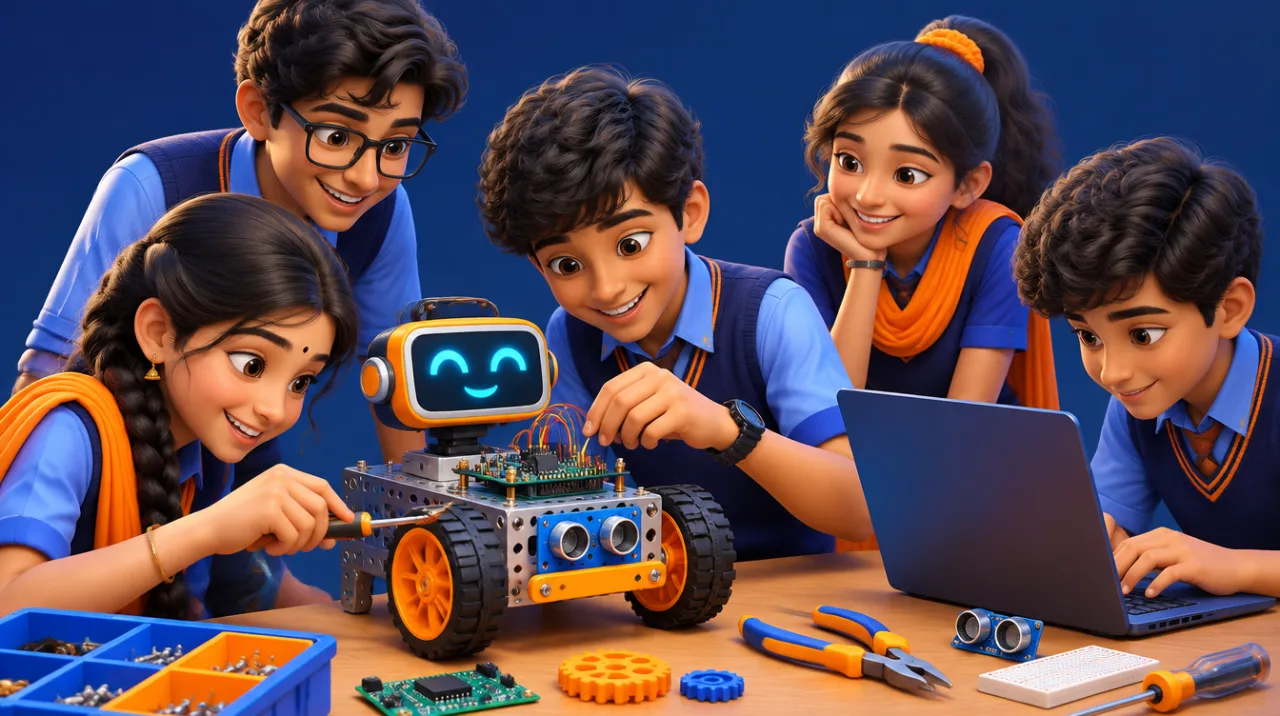 ⚙️
Robots are not just machines — they’re tools to teach logic, design, coding, creativity, and problem-solving. Introducing robotics to children helps them explore how technology works in the real world. Through hands-on activities, kids not only learn how to build robots but also how to think like innovators.
📘 Robotics & NEP 2020
As per the National Education Policy (NEP) 2020, education must foster scientific temper, creativity, and hands-on learning. Robotics is a perfect blend of:
- STEM (Science, Technology, Engineering & Mathematics)
- Critical thinking and innovation
- 21st-century skills like coding, automation, and design thinking
“NEP encourages experiential learning, where robotics becomes a gateway to future-ready skills.”
🚀 Why Robotics Is Important for Students
✅ Encourages innovation and creativity
✅ Builds problem-solving and design thinking skills
✅ Teaches teamwork and communication
✅ Introduces automation, sensors, and real-world tech
✅ Sparks interest in engineering and future tech careers
📗 Robotics – Grade-wise Pages (Click to View):
- 👶 Grade 1 – Introduction to Robots & Movements
- 🧒 Grade 2 – Basic Machines and Toys
- 🧒 Grade 3 – Introduction to Sensors and Motors
- 🧒 Grade 4 – Building Simple Robots
- 🧒 Grade 5 – Line-Following Robot Concepts
- 🧒 Grade 6 – Mechanical Design & Logical Flow
- 🧒 Grade 7 – Block Coding & Robotics Kits
- 🧒 Grade 8 – Automation, Loops, and Control Logic
- 🧒 Grade 9 – Arduino, Circuits, and Coding
- 🧒 Grade 10 – IoT, AI Integration & Robotics Projects
🏠 Try this at home: Build a hydraulic arm
You need two plastic syringes, a thin plastic tube, water and some cardboard.
- Fill one syringe and the tube with water and connect the second syringe.
- Fix one syringe to a cardboard “arm” that can hinge up and down.
- Push the free syringe — watch the arm lift!
This is how hydraulics power real excavators and robot arms.
💡 Did you know?
The word “robot” comes from the Czech word robota, meaning forced labour. It was first used in Karel Čapek’s 1920 play R.U.R.
❓ Frequently asked questions
Which grades is this program for?
Grades 1 to 10, with activities and content matched to each grade level.
Are classes online or offline?
Both. Many programs run in partner schools, and practice material is available online.
What happens in a robotics class?
Children design, build and program simple robots, adding sensors and motors as they advance — learning science, maths and coding together.
How do I join or book a free demo?
Fill in our enquiry form and choose this program. Our team will get back to you.
Give your child a head start in Robotics
Book a free demo class and see how AIMS makes learning fun and effective.